Showing posts with label semantics. Show all posts

Friday, May 3, 2013

Your Brain's Native Language


Suppose you know a person who speaks both English and French, but French is their native and primary language. If you wanted to communicate with them, you could choose either to talk to them in English or in French – either way would get the message across to some degree. But, suppose that you want to make your message easy for them to understand, then communication in French would be considered preference in regard to this goal. Fundamentally, we understand things most easily when they are communicated in our preferred language. 

That's pretty straight-forward. But I'm going to get into something slightly deeper: Your sub-conscious mind has a native language of it's own.

Primarily, we perceive the world around us through 5 senses: visual, auditory, kinesthetic, taste, and smell. These are the primary ways that we mentally represent reality, and these representations also give meaning to the language that we use to internalize or describe our experiences. That's a lot of long words to describe something simple: There is something in reality, I see that thing, and I create a mental visual representation of that object, and maybe even attach a name to that picture.

Here's the amazing thing, though: when people think about non-physical concepts, they also use these sensory-based representational systems to conceptualize it in their head. For example, if I want agreement with someone, I could say: “Do you *see* what I mean?” or “I *hear* what you're saying” or “I just want to be *on the same page* here.”


“On the same page”? We've just taken the invisible concept of agreement and conceptualized it using three different sensory systems. Your brain (and everyone else's) does this *all* the time. What varies is which sensory representational system people prefer. The three most common are visual, auditory, and tactile(kinesthetic, spacial). One of them is your brain's native language – the language it uses to make sense of the world.

When I first learning about this concept, I was fascinated to discover that me and my husband speak different mental “native languages.” I am much more visual. Every time I come across a concept, it's “Do you see what I mean?” or “from this viewpoint, you can see that this makes sense...” or “look at it this way.” Very visual metaphors that I constantly use without consciously thinking about it. My husband, though, thinks in spacial, tactile terms. With him, it's more about “coming across,” “steam rolling,” “finding common ground,” “where the rubber meets the road,” and so on.

Of course, no one sticks to just one type of metaphor, but each person usually has one type that they primarily prefer and use. If you listen to the language that people use, (or look at what they type), then you can notice if they primarily use visual, auditory, or tactile metaphors, and then you'd know what their brain's native language is. Is this helpful information? Absolutely, if you plan to communicate with them and want your message to be easily understood. When you know what their preferred representational system is, you can use those types of phrases and metaphors when talking with them. After all, we all understand things most easily when they are communicated in our preferred language.


Visual language examples:

I see what you're saying
That looks good
That idea isn't clear
My mind just went blank
Cast some light on the subject
Get a new perspective/point of view/view point
An insightful/enlightening/colorful example
Tunnel vision
In light of
Get the picture
Eye to eye
Beyond the shadow of a doubt
See to it
In view of
Catch a glimpse
Mind's eye
Mental picture
Brilliant
Oversight


Auditory language examples:

I hear you
That rings a bell
Sounds good to me
Everything just suddenly clicked
Listen to me
In harmony with
Something tells me not to
Harping on
That resonates with me
Word for word
Voice an opinion
Unheard of
Call on
Tuned out


Tactile language examples:

Grasp the concept
Get a handle on it
Pull yourself together
A solid understanding
I'm up against a wall
I have a feeling you're right
All comes down to this
Get in touch with
Where the rubber meets the road
Change your standpoint
Insensitive
Come up with
Underhanded
Come to grips with
On the right track
One step at a time
Pull some strings
Sharp as a tack
On your toes
A heated argument
Under my skin
Hit the nail on the head
Off-the-cuff
Crossing a line


This list is obviously not a complete list, but I hope that it includes enough to help you start seeing the patterns of language that can be used.  One fun thing to do is to listen to various songs, and notice which type of metaphor is used most frequently within that song.  Very fun.

Monday, January 30, 2012

A Triangle of Opposites


I've thought to myself, at times, that opposites aren't fully understood. They seem pretty straightforward, but they can be more complex than they are given credit for. Many of you readers, I'm sure, are familiar with the “Either/or” logical fallacy (also known as a False Dilemma). In this fallacy, there are more than three options, but person A presents the dilemma to person B as if there were two, and only two, choices.


Example:

Child: “Mamma, can I have a cookie now or later?”


The child presents only two options as an either/or choice, and tries to get the mother to not notice any additional option. You see, the child paints the question as if it's just a one dimensional choice - and that dimension is the dimension of time:

Cookies soon -------------------------------- Cookies later

Near time frame and far time frame. Two opposites, yes, but it ignores a third dimension: The dimension of how many cookies are given.

In the diagram above (I'm sure you will all be impressed at the creative artwork that went into that one), you can see both dimensions: Time, and amount of cookies. With this more comprehensive view of the situation, the mother also can see the option of not giving the child a cookie at all.

That specific example is easy and childish, but I think that we usually think of opposites as always coming in a pair, and many of them come in groups of three. For instance, what's the opposite of taking action to something good? Taking action to do something evil!


Doing evil ---------------------------------- Doing good


Perfect: We have our opposites. But could there be a third option which is the opposite of both? I say yes. This shows opposite sides of the dimension of morality here, but both involve action. The opposite of action is inaction, and therefore there is another dimension:

It may seem inconceivable that anything could have two opposites, because we are so used to used to thinking of opposites on opposite sides of a one-dimensional line. However, the pattern shows up again and again throughout life. For instance, the speaker in my class about christian principles in government tonight pointed out another triangle of opposites:
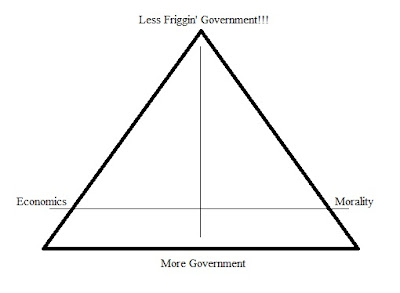
Often, we hear about being politically “to the left” or “to the right.” The far left might be communism or socialism; interested in large centralized government being used to create change and to redistribute wealth and take care of the society. One the far right is said to be fascism; the right perhaps encourages centralized government to keep things at the status quo, or to enforce moral boundaries (like no abortion). Many people can't explain exactly explain what dimension this measures – the best explanation I've heard looks like this:


More gov in economics --------------------- More gov in moral issues


So, if you buy into that scheme, whether you think of yourself being more “to the left” or more “to the right,” you are always in favor of more government. More, and more, and more government. But of course there is the other dimension as well:

Then I thought to myself about other opposites. There's hot and cold. Surely, there couldn't be an opposite to both of those! But then I thought to myself, spiritual beings may not have a physical temperature, and may not be either physically hot nor physically cold.

Finally, there's love. I've been a firm believer in the triangle opposites of love for a long time. If I ask people “what is the opposite of love?” most would say “hatred.” Love is passion for someone's betterment, and hatred is passion for someone's pain or destruction. We see hatred painted very clearly in stories where a person hates someone else, and then dedicates a lot of time and effort to damaging that person, even to their own detriment sometimes.


Desire for their betterment ------------------------ Desire for their harm


But both of these options involve passion. In both cases, the person is very emotionally involved. In either case, it can be self-sacrificing: Whether self-sacrificing love, or seeking vengeance even to the point of destroying one's own life. What is the opposite of both? Apathy. No passion for or against the other person; an apathetic person couldn't be bothered to take revenge, since they have their own life to lead.

Pathos versus non-pathos. (Passion versus apathy) On one dimension, we have desire for the other person's betterment or desire for their harm. On the other dimension, are you even having desire about their life at all?


Wednesday, October 12, 2011

Levels of Involvement (Definitions)


If one person takes action, or makes a choice, to what level can another person, or being, be involved with the process? This is a list of various levels of involvement, ranging from the least involvement to the most, complete with definitions and explanations. Many people also view greater involvement as implying greater responsibility.


1 – Ignorance

To be unaware. I am ignorant of any specific sins being committed in China right now.


2 – Uninvolvement

The opposite of being involved. If I hear about a situation involving my brother and some other boy at school, I am not ignorant, but I can choose to remain completely uninvolved with the matter.


3 – Helplessness

To be uninvolved because you do not have the ability to be involved, or to be involved in such a way where you cannot influence the outcome in any way.


4 – Allow

Allow implies complete absence of an attempt, or even an intent, to hinder. Allow is more passive; if you do nothing, and therefore the crime happens, you have allowed it.


5 – Permit

Permitting is similar to allowing, but is more active; if they have to get your permission before doing a crime, and you give permission, you have permitted the sin.


6 – “Cause in Fact”

A cause, without which, the result would not have occurred. The person who assembled this laptop keyboard is a cause-in-fact for me typing up this document with this keyboard.


7 – “Aid and Abet”

To assist another in the commission of a crime by voluntary and uncoerced words or conduct. For instance, if I lend my car to a friend, so that they can use it as a quick getaway car, that would be aid. [Note: The legal system also insists that the person giving aid must have criminal intent, but I do not use that meaning here.]


8 – Synergism

Combined action or functioning; two or more energies working together. Two batteries working together is synergy. If I hold the toast, while you butter it, we have synergistically produced buttered toast.


9 – Catalyst

Anything, as an act or event, that serves as a stimulus and triggers or precipitates a reaction or series of reactions. A simple yell can easily trigger a massive avalanche. Similarly, a small protest can be the catalyst for a mass demonstration.


10 – Entrapment

Setting up a situation in order to make it more likely for a criminal to commit a certain crime, which they are in the habit of committing, in a place where they can be caught and prosecuted for it. If I was a policeman, and tried to set up a meeting to buy heroin, just so I could catch the dealer in the act of selling drugs, that would be entrapment.


11 – Giving Ideas

To not completely mastermind the crime, but to have some ideas about how to commit the crime, and then to suggest those ideas to the person who you know plans to commit the crime. Suggesting an escape route, or tactic to avoid detection, for instance.


12 – Light Influence

Light influence would be to try to get someone to do something by lightly influencing them – suggesting the idea, offering a bribe, warning them of what would happen if they don't, etc. It is influence, but not such influence that it would force their hand, like “overwhelming influence.”


13 – Mastermind

A person who supplies the directing or creative intelligence for a project. To plan and direct (a usually complex project or activity), especially skillfully. Inventing and planning out a specific scenario.


14 – Command

Commanding someone to do something. If a spirit is doing this, the command can be written (like in the Bible), audible, or sent directly to the person's mind.


15 – Persuade

Using reason (or some semblance thereof) to persuade someone to do something. If a spirit is doing this, the persuasion can be written, audible, or sent directly to the person's mind.


16 – Tempt

Tempting someone to do something. If a spirit is doing this, the temptation can be written, audible, or sent directly to the person's mind/will/emotions/spirit/soul.


17 – Indoctrinate

Indoctrinating or even brainwashing someone to believe something which would make them actually carry out the desired action. If a spirit is doing this, the indoctrination can be written, audible, or sent directly to the person's mind.


18 – Inspire

Guiding, prompting, and/or filling someone with an animating, quickening, or exalting influence to do something. If a spirit is doing this, the inspiration must be internal and directly involved with the person's mind/will/emotions/spirit/soul.


19 – Manipulate

Skillfully manipulating someone to do something; this usually involves knowing how to manipulate people, and how to “push their buttons,” so to speak. If a spirit is doing this, the manipulation may include manipulating circumstances around the person's life (to get them to react), and may also include directly sending thoughts and feelings to the person involved.


20 – Incite

Instigating, provoking, or urging someone on to do something. If a spirit is doing this, the inciting is internal and directly involved with the person's mind/will/emotions/spirit/soul.


21 – Inception

Putting the idea in someone's mind in such a way that they take the idea as their own, rather than rejecting the thought. (See “Inception” movie). If a spirit is doing this, the inception is internal and directly involved with the person's mind/will/emotions/spirit/soul.


22 – Overwhelming Influence

The situations where “overwhelming influence” is involved are the situations where people generally claim that they “had no choice.” Bribery may be light influence, but putting a gun to someone's head is overwhelming influence. Overwhelming influence is putting someone in a situation where they do have a choice, but it would be impossible or nearly impossible for them to choose against what you want them to choose, and they know it. The person feels “overwhelmed” by the influence, and gives in to the desires or demands of the one exercising the overwhelming influence.


23 – Drugging the person

To effect a change in a person's brain chemistry in order to take away a person's consciousness or rational control so that they become unaware, or extremely susceptible to suggestion. For instance, giving someone “truth serum” to make them tell the truth would be drugging the person


24 – Complete Mind-Control (like a robot)

To control a person's psyche so completely that you can completely determine all of their actions, in such a way that you also make them want to do what you cause them to do. The only real life example that can be used is that of a robot, whose every thought and action is completely determined by the programmer. Fictitious examples include numerous stories of people “hypnotizing” others to control their mind, or inventing “mind-control hats” and the like. [Also see “The Stepford wives,” and “Simon Says,” which an episode of “Underdog”] Brainwashing does not count as mind-control.


25 – Puppetry (like a puppet-master & puppet)

To control a person's actions, without making them believe that they are the one initiating the action (mind-control), but also without them being against the action (which would be force).


26 – Physically force, against their will

To make someone do something that they do not want to do, and that they know they do not want to do.

Friday, October 7, 2011

Following the Strongest Desire

“Not only will we always choose according to our strongest desires, we must always choose according to our strongest desires.”

R.C. Sproul

“In summary of Edwards’ view of free will, he believes that man is free in that he can and does choose according to his strongest inclinations — his desires.”

W. Tullian Tchividjian

I don't agree with these claims, but it's hard to argue with it when the argument is generally presented in a circular fashion. I've debated it briefly with some Calvinists before, and it usually goes like this:

"You always choose based on your strongest desire."

"How do you know what someone's strongest desire was?"

"It was the one that they chose.”

If you define "strongest desire" as "the one that matches the choice made," then you can prove that the choice made always matches the strongest desire. But as soon as you get down to "what non-circular definitions of strongest desire can you give?"

If you define "strongest desire" as "the desire that pops to mind most frequency in the minutes before you take the action," then hypothetically a person could disprove it and say "No, I had X desire pop to mind 50 times in 5 minutes, but I also wanted to do righteous action Y, which came to mind 2 times in that period. Then I prayed about it and within 15 seconds took action Y."

If you define "strongest desire" as "the choice that you usually make in this situation," then a person taking a new path would disprove it.

If you define "strongest desire" as "the one which effects your physical/mental chemistry most negatively before you take the action (which relieve the negative chemical balance)," then a drug addict who stops using would have chosen against their "strongest desire."

But as long as we accept the definition of "strongest desire" as "that which motivates your action," it is indisputable that "your actions are always motivated by your strongest desire." It's true by definition in that case. For myself, I do not buy into this circular definition, though. I don't find it true, helpful, or useful in debating larger concepts like free will.


Wednesday, August 3, 2011

Introduction to Positive Manipulation

Manipulation.

I think that most people would agree this word comes laden with all sorts of negative connotations. Personally, I use the word more loosely than that. But first let's look at what Dictionary.com has to say about the word:

Manipulate (məˈnɪpjʊˌleɪt)

— vb

  1. to handle or use, esp with some skill, in a process or action: to manipulate a pair of scissors

  2. to negotiate, control, or influence (something or someone) cleverly, skilfully, or deviously

  3. to falsify (a bill, accounts, etc) for one's own advantage

  4. (in physiotherapy) to examine or treat manually, as in loosening a joint


Now, feel free to discard my thoughts about the word manipulation itself, because I know and accept that I use the word differently than most people use, but I find it very useful. You see, I believe in positive and negative manipulation. Manipulating objects, for example, may or may not take skill. It's easier to manipulate a steering wheel to the desired result than to manipulate a violin to produce the sounds you want to hear.


Manipulation always involves some sort of end goal. The one nice thing about inanimate objects, of course, is that they tend to be very predictable and therefore are easier to manipulate than animate substances like people or animals. (The obvious exception to that statement is computers. They get moody.) I can easily manipulate a chair to move to the right simply by pushing it gently. Although manipulation gets a bad rap most of the time, it clearly doesn't apply to the manipulation of objects, since there are no negative connotations associated with that. In fact, if a person made it a point to never move any objects, they would find it very impractical.

Manipulating people is slightly harder, since they can actually make decisions and choices, and takes a lot more understanding, skill, and patience. Unlike the chair. I realize that “manipulating” people sounds bad. When I say “manipulation,”though, I am referring specifically to manipulation other people to act or think in a certain way. That concept scares people, because when people think of others trying to manipulate them, they usually think of salesman, con men, or pushy, passive-aggressive acquaintances.

"You can trust me completely."


The general feeling seems to be that “If someone is trying to manipulate you, it's sneaky, deceptive, and it's for their good and not yours.” That is one type of manipulation, but I would add that there are many other types of manipulation as well. Whether manipulation is good or not depends on the end goal. Quite simply, manipulation (when it comes to manipulating people) can be defined as follows:

Manipulation is making a certain choice easier for someone.


This definition certainly includes the above mentioned negative examples. If a conman lies to you, he is making it easier for you to make a bad decision which would benefit him. If a salesman offers a payment plan, he is making it easier for you to buy now (and pay later). If someone pressures you emotionally into giving them a ride somewhere, they made it easier for you to choose to just get it over with and drive them to their destination.

On the other hand, this definition also includes many positive interactions. If I hold the door open for someone, I am making it easier for them to decide to go ahead of me. If I offer to pay for dinner, I am making it easier for the other person to decide to have dinner with me. In fact, much of social etiquette is about acceptable manipulation. It is polite to say “come on in” when a guest arrives at your house, and that makes it easier for them to decide to come in. You could just walk toward your living room, and if they are your friend, they will probably know to follow, but that's just not as polite. Asking “would you like some help with that?” makes it easier for the other people to request assistance.

Now, there are also a couple other ways of achieving a goal that involves another person. Let us take for a given that you wish to change someone's behavior. In this instance, let us suppose that you wish for your best friend to go through the door before you do. Let us suppose also that you have a good motive; you think that having someone go first shows respect for them. Now, how can you achieve that goal of getting them to go first? I would say that you have three general options: Power, Influence, or Manipulation. Here are three ways it could go:


Power (force or command): “You need to go in first.”

Influence: “I think that you would enjoy going in first, so go ahead.”

Manipulation: (Opening the door for them)

Positive manipulation is usually referred to as “influence,” which has no negative connotations. However, I think that the word “manipulation” fits better to describe a skillful, subtle, and understated form of graciously making a choice easier for someone. Yes, I do think that positive manipulation is a lot like grace. I'll explain:

Temptation is bad manipulation - it makes it easier for a person to say yes to sin

Grace is good manipulation - it makes it easier for a person to say yes to God

To give another practical example, bad manipulation would be to manipulate you into giving me all your money; I gain, you lose. It's bad because of the end result that I'm shooting for. Good manipulation would be manipulating you into accepting money for food, when you're feeling too proud to accept help. Helping people is gracious. When a Christian confronts someone about sin, they are called to speak “graciously.” This doesn't mean avoiding the ugly truth, it simply means that we are to speak in a way that makes it easier for the other person to make a certain decision (repent).

Obviously, because manipulation is not control, though, people are always free to make the opposite decision. And this is where skill comes in. I mentioned previously that it's easier to manipulate some objects (like pans) to a certain goal than to manipulate other objects (like rockets). Manipulating people also takes a lot of skill. Suppose that you want to influence a person to accept help, but you don't know how. You would need the knowledge, skill, and even practice to make that process a smooth one. It's much easier to accidentally manipulate people to do the wrong thing, actually.

I would go as far as to say that most of the time, when we are around other people, we are unconsciously manipulating them in some way. The more conscious our goals and efforts are, though, the more likely it is to turn out in a positive fashion. We are always making this or that choice easier for people, and the question of whether that manipulation is good or bad must turn to the question of the end goal: Are we manipulating people to their disadvantage, or to their advantage?

Some people are very unpleasant, and behave rudely toward the people around them. They get to the end of the day and wonder “why is everyone always so mean to me?” It's very simple. It's because they accidentally manipulate everyone to be mean to them. I don't mean that being rude and unkind forces people to be rude and unkind to you, but it certainly does make that choice easier to make! On the other hand, those who are genuinely warm, helpful, and even humorous to the people around them sometimes manipulate all those people into a good mood. Most everyone likes to be around those who manipulate them right into a good mood!


Hugs usually manipulate me into feeling happy and cared for


If you want to manipulate someone into doing you a favor, sometimes it helps if you do favors for them when they ask it. If you want to manipulate someone into refusing to help you, all you have to do is sabotage their work a few times, and do them no favors. That will make it a lot easier for them to refuse to help you.


As for personal application, I believe that only certain types of manipulate are acceptable, and only certain types are actually helpful. Personally, I try to only manipulate people honestly, and for their own good. I wouldn't use deceit to make a choice easier for them, because that would be wrong and unloving. That would not be very trustworthy. Also, I don't think it would be right if I manipulated people into making choices that would benefit me and would not benefit them. If a choice is not best for them, then I would not try to manipulate them to make that choice. (Of course, I don't have a whole lot of skill at influencing people in a smooth fashion... but maybe someday my people skills will improve.)


Dimensions of Manipulation:


_

Thursday, April 14, 2011

The Authoritative Dictionary of “Yo”


The reference guide that you all have been waiting for! This dictionary defines clearly the twenty-five different standard meanings of the word.

If you thought that this word is simple, prepare to be enlightened. If you are confused about how to interpret a word with so many different meanings, let me just clarify that you can usually figure out how it's being used by the tone of voice, facial expression, context of situation, and relational context. For example, two friends would not use the word “yo” to mean #11, etc.


  1. Hi

  2. Hi!

  3. Hi :)

  4. I like you

  5. I'm happy

  6. I'm sad

  7. I want your attention

  8. (filler word)

  9. I've had a long day and I'm happy to see you

  10. You make me happy

  11. I love you

  12. I agree with you

  13. I don't have a response to that

  14. You are awesome

  15. I love looking into your eyes

  16. You keep making my mind go blank

  17. You are cute

  18. I don't want you to leave

  19. I'm sad, but it makes me feel better to know that you care

  20. Where'd you go?

  21. I'm sad cus I'm sorry

  22. I'm sad cus you seem to be unhappy with me

  23. I care and empathize with you

  24. It's nice just to be here with you

  25. I just wanted to say something


Friday, February 25, 2011

All means All and that's All All means

As I was reading "The Bondage of the Will," by Martin Luther (translated into a language I understand by J.I. Packer and O.R. Johnson), one thing that I really appreciated was Luther's understanding and respect for the word "all."

Now, the word "all" refers to different qualities in different contexts, and that's important to remember. For instance, saying "I am holding all the money that I own" refers to a smaller quantity of money than does the statement "My parents own all the money in the world." The word "all" is used to delineate or refer to everything within a particular set of boundaries.

Sometimes this set of boundaries is stated very clearly: "I own all the crayons in this box."

Sometimes this set of boundaries is stated in an implicit, but obvious, way: "You guys ate all the pizza (that our parents bought and brought home tonight)!!!"

No one would accidentally suppose (unless they had a learning disability of some sort) that the above remark was an accusations that the "guys" had eaten all the pizza in the whole world, or even in the whole state.

Now, if the set of boundaries is meant to be implicit, but is not clear, then it's poor communication, a bad joke, or just an attempt to get on someone's nerves:

"I rescued all of your pets from your home before it burned down. Well, no, I didn't get Jojo or Fifi, but I got Doc and Jiji! When I said 'all of your pets,' I mean 'all without distinction,' not 'all without exception.' I rescued one of your dogs AND one of your cats!"

[Note: It is equally annoying if you say "all," and people misinterpret it to say that you "really meant" just "some." For instance:

Mom -"I want all the dishes dishes in this house to be done when I get home."

time passes ...

Mom - "Why are the dishes not all done?"

Son - "I don't know what you are talking about. I did all of the dishes that were hidden in my room at the time you gave the order. I knew that you couldn't possibly have meant more than that, because you are very reasonable person."]

So, in all, if you are trying to delineate or refer to everything within a particular set of boundaries, it is your responsibility to make sure that the boundaries are plain and obvious. If the boundaries are obvious, then they can be stated implicitly, but it not, it is necessary to spell them out in explicit terms.

And all of this has to do with...? My appreciation for Martin Luther's understanding of the word "all," as referred to in his book.

"There are no obscure or ambiguous words here: the gospel of the power of God is necessary 'to Jews and Greeks', that is, to all men, that they may by believing be saved from from the wrath revealed."

"By saying 'all,' he exempts none."

"When he says 'all,' he excepts none; not the power of 'free-will', nor any worker, whether he works and endeavors or not; he is of necessity included with the rest among the 'all'."

"Speaking for myself, I am astounded that, when Paul so often uses these comprehensive terms, 'all', 'none', 'not', 'never', 'without', as in: 'they are all gone out the way, there is none righteous, none that doeth good, no, not one'; 'all are sinners condemned by the offense of one'...

I am amazed, I repeat, how it has happened that in face of these comprehensive terms and statements, others that are contrary, yes, contradictory to them should have won acceptance, such as: 'Some are not gone out of the way, are not unrighteous, are not evil, are not sinners, are not condemned; there is something in man that is good and strives after good'; as though he who strives after good, whoever he may be, is not covered by the terms: 'all', 'none', and 'not'!"

"Personally, I could find nothing, even if I wished, to advance in reply against Paul, but would be forced to myself the power of my own 'free-will', and its endeavor with it, among the 'all' and 'none' of which Paul speaks -- unless we are to introduce a new grammar, and a new mode of speech!"

"Had Paul used such an expression once, or in one place only, it might have been permissible to suspect a figure of speech and to isolate and strain the words. But as it, he uses such expressions constantly, in both affirmation and negative sentences..."

Impeccable logic! But compare this with some misguided claims of today:

Then compare those claims to what the Scripture actually says, when you allow it to speak for itself:

"The Lord is not slack concerning His promise, as some count slackness, but is longsuffering toward us, not willing that any should perish but that all should come to repentance." 2 Peter 3:9
"Truly, these times of ignorance God overlooked, but now commands all men everywhere to repent" Acts 17:30
"For this is good and acceptable in the sight of God our Savior, who desires all men to be saved and to come to the knowledge of the truth.” 1 Timothy 2:3-4
"And He Himself is the propitiation for our sins, and not for ours only but also for the whole world." 1 John 2:2

"And if anyone hears My words and does not believe, I do not judge him; for I did not come to judge the world but to save the world." John 12:47

"Who gave Himself a ransom for all, to be testified in due time" 1 Timothy 2:6
"But we see Jesus, who was made a little lower than the angels, for the suffering of death crowned with glory and honor, that He, by the grace of God, might taste death for everyone." Hebrews 2:9
"For God so loved the world that He gave His only begotten Son, that whoever believes in Him should not perish but have everlasting life. For God did not send His Son into the world to condemn the world, but that the world through Him might be saved.” John 3:16-17

'Any', 'all', 'all men everywhere', 'all men', 'everyone,' 'the world', 'the whole world.'
There are no obscure or ambiguous words here.

For those who would say "but the world only means the elect from around the world," I would say that if, when
God had the word “all” penned, He had only meant "the elect," He could have easily had that written. The word "elect" was, in fact, a regular part of New Testament vocabulary (see Mt 24:24, Mk 13:22, Luke 18:7, 1 Peter 1:2, Rom 8:33, Col 3:12, 1 Tim. 5:21, Titus 1:1) This is also true of the words "some" and "few."

Yet in the whole Bible, in the whole New Testament, not once does the Bible say that God only loved the Elect. Rather, we read again and again, positive affirmation that He loves all of mankind, and not because we deserve it; but because He is who He is.

It should be fairly clear to anyone reading the text in earnest that God loved the "world" so much that He gave Christ to die for that same "world," which is the same whole "world" that is in danger of being justly condemned. The Bible says "the world," it means "the world," and it is clearly the same "world" that deserves condemnation.

God is love, God loves the world, God loves all, and God loves all men. I see throughout the Scripture a landslide of verses that clearly teach this point. There is no one, whoever he may be, who is not covered by the terms: 'all', 'everyone', and 'all men everywhere'!" With Luther, I reason "Had [the Scripture] used such an expression once, or in one place only, it might have been permissible to suspect a figure of speech and to isolate and strain the words.” But as it, the constant use of such expressions much lead us to agree with Martin Luther on at least one point: "By saying 'all,' he exempts none."

Correct usage of the word "all":

“If I were hungry, I would not tell you; For the world is Mine, and all its fullness.” Psalm 50:12


Tuesday, September 22, 2009

Monergism Vs Synergism

Before I try to define monergism or synergism, I'd like to define the roots of both those words.

Synergy:

  • From the Greek syn-ergos, συνεργός meaning working together) is the term used to describe a situation where different entities cooperate advantageously for a final outcome. Synonymous with "teamwork" and "division of labor." [1]

  • Combined action or functioning; synergism. [2]

Monergy:
I couldn't find a definition for this word, but since "syn-" is more than one, together, it seems apparent that the prefix "mono-" means just one, alone. (As in the phrase "dihydrogen monoxide" which means two hydrogen and one ogygen) Monergy would then mean one energy source working along.


___________________________________________________________
Moving on from that, let's look up the words "monergism" and "synergism."
These words are generally used only to discuss the theological concept of regeneration, I have found several different definitions:

Synergism:
  • In general, it may be defined as two or more agents working together to produce a result not obtainable by any of the agents independently. The word synergy or synergism comes from two Greek words, erg meaning to work and syn meaning together, hence synergism is a "working together." ...essentially the view that God and humanity work together, each contributing their part to accomplish salvation in and for the individual. [3]

  • Teaches that God and man work together in salvation.[4]

  • The doctrine that there are two efficient agents in regeneration, namely the human will and the divine Spirit, which, in the strict sense of the term, cooperate. [5]

Monergism:
  • Doctrine advanced by some Lutheran theologians that spiritual renewal is exclusively the activity of the Holy Spirit. [6]

  • The teaching that God alone is the one who saves. [7]

  • Monergism (Greek mono meaning "one" and erg meaning "work") is a term for the belief that the Holy Spirit is the only agent who effects regeneration of Christians. [3]

  • In regeneration, the Holy Spirit unites us to Christ independent of any cooperation from our unregenerated human nature. [5]

Now, these definitions seem to stay mostly true to the original concepts. Synergism is the energy of God and man working together to regenerate the individual. Regeneration is a synergistic effort in which both agents together cause the result. Monergism, on the other hand is God working to save the individual without any help from anyone. God is the one agent who causes regeneration.

Going from that, I would say that I very strongly believe in monergism. God saves us. We do not save ourselves. We cannot save or regenerate ourselves. God made us the first time, and only He can make us a new creation. We cannot even "help" regenerate ourselves somehow. Only God has that kind of power. The energy that causes and produces regeneration comes from one source: the Lord Most High. The idea that God and man would somehow work together to regenerate the person is ridiculous. In fact, I have yet to meet a christian who believes that God and man work together to regenerate a person.

___________________________________________________________
Other definitions that are go a bit further in their claims:

Monergism:
  • "...means that the very desire for faith, by which we believe in Him who justifies the ungodly comes to us through regeneration "[5]

  • "According to monergism, faith in Christ only springs from a heart first renewed by God."[1]

Synergism:
  • "To the synergist, faith may arise from unregenerated human nature." [1]

My word! What does inability to have faith have to do with what energies are involved to save a person? Here we come to something very important. I mentioned before that I have never met even one christian who believes that God and man work together to regenerate a person. Where, then, did this concept of "synergism" come from?

___________________________________________________________
What in the world?

As far as I can tell, it came from calvinists trying to describe the belief system of their opponents.

What calvinists believe:
God regenerates people who do not have faith, by His power and His alone, and as a result, those people will turn to Him in faith.


Non-calvinist christian in general believe:
God regenerates people, by His power and His alone. He chooses who to regenerate based on a condition: faith. The faith neither assists in salvation, neither somehow earns or merits the salvation. Salvation does not depend on the faith, but on God, and those with faith do not deserve to be saved.


The calvinists then describe their opponent's position as:
"...the doctrine that there are two efficient agents in regeneration, namely the human will and the divine Spirit, which, in the strict sense of the term, cooperate."[5]
"...essentially the view that God and humanity work together, each contributing their part to accomplish salvation in and for the individual."[3]


Seeing as the non-calvinists very specifically deny that they believe in synergism, why do the calvinists say that non-calvinists believe it? Well, to the calvinist, it seems logical that if the condition is faith, faith must somehow be a part of the salvific process. That faith is man's will working together with God to save him. They believe that this logic is necessary, and therefore to say that one must have faith to be saved, one must believe in synergism. To me, that seems quite illogical.

Now, it seems to me that everyone agrees that there is only One that saves or regenerates, and that is God Alone. The condition on which the action is taken is completely separate from the energy or process of the actual action. The condition of faith is completely separate from the energy and process of God regenerating people. For a blunt example, let us suppose that I punch everyone who calls me "Becky" hard enough that they are knocked unconscious. The condition of calling me "Becky" is entirely separate from the energy of process of me punching them hard enough to knock them out.


___________________________________________________________
Previously, I said that I believe in monergism, and by those first definitions I do.
I believe that God, by His power and His alone, saves and regenerates us. However, if we are going by the extended definitions that include God saving people who do not have faith, I would have to say that I do not subscribe to that belief.

I do not believe in synergism, as I said before. Man does not "co-operate" with or somehow "assist" God to redeem or regenerate himself. The idea is preposterous! However, if we are going by the definition that "faith may arise from the unregenerated human nature," then yes I agree with that part of that definition, but would say that the wrong word is being used! That's like saying that believers will be damned, and then defining "damnation" as "going to heaven," in which case I would agree that believers will go to heaven, but would say that "damnation" is not the right word to express that concept!

Things would go a lot smoother if everyone were using the same definitions. I believe that the "extended" definitions do not fit the orignal concepts at all. That is why by the first definitions, I agree with one and disagree with the other, and yet by the "extended" definitions, I disagree with the one and agree with the other!

I believe that monergism should be solely defined as:
God, by His power and His alone, saving and regenerating a person.

Synergism should be defined as:
The action of regenerating the person is accomplished by God and man's power combined.

Let's keep it to the original concepts.


___________________________________________________________
Final Example

Here I will include one last example of how the condition on which the action is taken is completely separate from the energy or process of the actual action. I am driving alone the road, and see a small body slumped on a sidewalk. I pull over, and see that there are two people lying unconscious on the pavement: an old man, and a girl who appears to be about five. I check for a pulse, and find that both of them are still alive. I think for a moment, and decide that I really don't care about the old guy, but will take the little girl to the hospital because she is so young and cute. I don't have a cell phone, or any change, and it's a bad neighborhood, so I decide to pick her up and put her in my car, and drive her to the emergency room. She makes it to the hospital, and they save her life.

Reviewing the story, the condition on which I took the girl to the hospital was that condition of being young and cute. That condition was completely separate from the energy and process of me carrying her to the car, driving her to the hospital, and them saving her life. She did not somehow assist me, and yet she fulfilled a condition. In a similar way, the condition of salvation is completely separate from God's energy and process of saving and regenerating a person.


---------
1 - wikipedia.com
2 - dictionary.com
3 - theopedia.com
4 - http://www.godweb.org/dictionary/dic_l-o.htm
5 - http://www.monergism.com/what_is_monergism.php
6 - thefreedictionary.com
7 - www.spiritrestoration.org/Theological_Terms/Laity_to_Orthodoxy.htm

Thursday, September 17, 2009

The Frustration of Logomachy


Tuesday, September 8, 2009

Nothing is Unconditional


I woke up the other morning with the thought it my mind that nothing is truly unconditional. Nothing has no conditions at all. Same with the word "all;" it always means "all within these certain parameters." Think about something unconditional. Let's suppose that I say that I unconditionally love everyone. That would simply mean that I love people with who meet these conditions:
  • -They must exist
  • -They must be people
  • -I must be aware of their existence
Wow - three conditions! Whatever happened to having no conditions? Can anything truly have no conditions whatsoever? I cannot think of anything that has no conditions whatsoever. If any of you can, then I'd love to hear about it.

So then, if nothing actually has no conditions whatsoever, then what is the difference between conditional and unconditional? How could we define the terms so that we can practically use them? It would be pointless to define a word as something that does not exist. In fact, that is why I object to defining "free" as something more than even God has, for He is the most free being of all. What is the actual difference between what we call unconditional, what we call conditional, and what we call random?


_________________________________________________________
Unconditional: An offer that first determines eligibility with core conditions, and then is enacted for all those who are eligible, whether or not any other conditions are met.
Example: Unconditional love
Core Conditions to determine eligibility:
  • -Must Exist
  • -Must be Human
  • -I must know of their existence.
I will love everyone who fulfills these conditions, and will not cease to love them because of any other conditions.


Random: An offer that first determines eligibility with core conditions, and then is only enacted for select individuals who fulfill conditions which are designed to be most like non-conditions.
Example: A raffle
Core conditions to determine eligibility:
  • -You must exist
  • -You must be human
  • -You must be at a certain event
  • -You must be capable of getting a raffle ticket
  • -You must choose to get a raffle ticket
  • -You must obtain said ticket before the raffle begins
  • -You must not get caught cheat
When all those conditions are met, perhaps twenty people have raffle tickets, but perhaps there is only one prize. I must select only one of the eligible people, so I add some more conditions, which are similar to non-conditions.
  • -You must have a ticket that does not have the same number as any one of the first seven tickets I pull out of my hat and rip up
  • -You must have a ticket that does not have the same number as the next five tickets that I burn
  • -You must have a ticket that has the same number as the ticket on the top, right-most section of my hat that I pull out
If you meet all those conditions, which are designed to be arbitrary and unlike meaningful conditions, then you will get a prize!

This is what we call random. Programmers also design "random number generators" which cannot actually generate a number based on no condition whatsoever, but can be programed to pick different and unpredictable numbers every time by programming several conditionals which are dissimilar to normal meaningful conditions.


Conditional Based on Factors You Cannot Determine: An offer that first determines eligibility with core conditions, and then is only enacted for select individuals who fulfill conditions which they cannot determine.
Example: Racism
Core conditions to determine eligibility:
  • -You must exist
  • -You must be human
  • -I must know of your existence
There are many people who fulfill these core conditions, but I don't want to persecute all of them. So here are some added conditions to narrow it down; conditions which they have no influence or control over fulfilling:
  • -You must be mainly a different race than I
  • -You must obviously be that race
  • -I must have a feeling against that race in particular
If an eligible person fulfills those conditions, through no power of their own, they will receive free persecution from me.

Now, as an added note here, not all offers that are Conditional Based on Factors You Cannot Determine are morally wrong. For example, I only date guys. That is condition based on something people have no control over, and yet it is morally right and fine. It only becomes unjust or unkind when the offer is negative or hurtful. For instance, if I punch every guy I meet, that would not be right anymore.


Conditional Based on Factors You Can Determine: An offer that first determines eligibility with core conditions, and then is only enacted for select individuals who fulfill conditions which they can determine. [Yes, this operates under the assumption that a person can determine stuff. A person is a free agent and determines his or her own choices]
Example: A Sale
Core conditions to determine eligibility:
  • -You must exist, be human, etc
  • -You must be selling a product that I want
  • -You must not be charging more than I am willing to pay
  • -I must not be aware that you are untrustworthy
Still, even if I want to buy something from you, and am willing, based on those conditions, I will not give you money until you fulfill a certain additional condition that you can control:
  • -You must give me the merchandise
Only if you choose to fulfill that condition will I give you money.

As an added note: Not all conditional offers are just and kind either. If I shoot everyone who gives me merchandise, that it conditional based on something they can control, and yet is not just or kind.


Conditional Based on Factors that I Determine: An offer that first determines eligibility with core conditions, and then is only enacted for select individuals who fulfill conditions which only I can determine.
Example: Hypnosis Show
Core conditions to determine eligibility:
  • -You must exist, be human, etc
  • -You must be attending my show
Now there are a lot of people attending my show, but I only want to hypnotize some of them. So I choose that I will only hypnotize the ones that fulfill this one final condition:
  • -They must be pointed at by me
And only if they meet that condition will I hypnotize them. The problem with this type of conditional offer is that it doesn't actually tell us anything. It only begs the question: What were the conditions I used to choose who I picked?


_________________________________________________________
So there you have it. Those are the four true types of offers, and one false type. It's all very interesting to be sure, and I hope I didn't make it too confusing.

So now the question of the day:
Which category does the offer of salvation fall under?
Which category does election fall under?
Hmm....